

This week I had the privilege of interviewing Lou Hoffman, CEO of The Hoffman Agency. The Hoffman Agency is a technology PR agency based in Silicon Valley with offices in the United States, Europe, and Asia Pacific. He was the perfect candidate to provide insight into the intersection between PR, technology, and climate change. Let’s dive in!
Q: Describe your current role and responsibilities.
A: I’m the CEO of a global communications consultancy called The Hoffman Agency.
My overarching responsibility is to help our 300 plus employees deliver a world-class product to our clients.
Drilling down to the next level, I focus on four macro areas: 1) workplace 2) service delivery 3) brand building and 4) financial performance.

Because we’re often competing against agencies that are 10X or more larger than us, differentiation becomes a critical success factor. Here, I view our superpower as collaboration that transcends geography. This is how we differentiate our proposition for multi-country (global) opportunities.
Q: How does PR impact technologies related to climate change?
A: Like all professionals, the PR industry needs to do its part to reduce its carbon footprint.
But PR’s greatest impact on climate change comes from helping the technologists as well as the policy makers communicate what needs to be done to ensure we have a sustainable planet. There are extremely complex and emotionally-charged issues surrounding climate change.
In a sense, this communications “campaign” started with the Al Gore film, “An Inconvenient Truth” back in 2006.
Q: How can PR strategies be leveraged with technology to raise awareness of climate change issues?
A: Human beings naturally gravitate to the status quo. They don’t like change.
With this mind, PR strategies shouldn’t lecture people. Instead, effective PR strategies should generate both intellectual and emotional touch points as well as offer paths to take action.
I wrote a post back in 2020 on how I would respond if the FDA called me for counsel on getting society on board with the vaccine. You can read it (here). Many of the same principles, creative treatments and tactics hold true for mobilizing people to address climate change.
Q: How can PR professionals effectively communicate complex scientific concepts related to technology and/or climate change to the general public?
A: PR needs to break down the complexity into understandable and digestible pieces.
Here’s one quick example from years ago but still relevant to this topic.
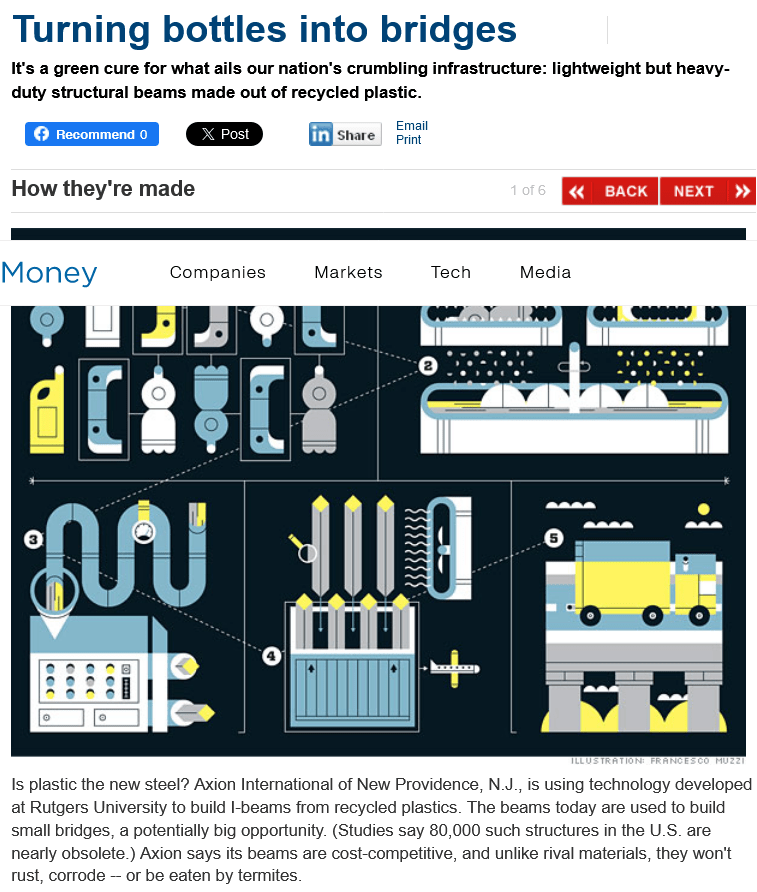
There’s a company called Axion International that had invented a process to transform recycled plastic bottles into the equivalent of steel beams. This line is on its website:
- “This thermoplastic composite is made out of high density polyethylene (HDPE) with polypropylene encapsulated glass fiber reinforcement.”
Most people have no clue what that line means.
If you go to a visual depiction of the Axion process in Fortune Magazine at (here), you can see how the journalist breaks it down so the average person can grasp the process.
Q: What are some best practices for creating collaborations between PR/marketing professionals and technology experts?
A: It starts by taking a holistic approach to communications. In short, we should be channel agnostic.
This way, from the front end we’re creating campaigns that incorporate earned media as well as paid media and owned media. Such an approach “forces” collaboration between PR and marketing.
Q: How do you see the intersection between PR, marketing, technology, and climate change evolving in the future?
A: First things first, PR can’t spin climate change stories. That gets us nowhere.
Which brings me to what I consider to be the underlying principle for PR to tell the climate change story that leads to change and ultimately a sustainable planet: PR needs to have a seat at the table and a voice in shaping an organization’s behavior/decisions to lower its carbon footprint.
If you’ll bear with me for a moment, let’s rewind the tape to August 2019 when Business Roundtable proclaimed that the purpose of business is not just to crank out profits, but that corporations should care about their employees, suppliers and the environment. Here’s the New York Times proclaiming this seminal moment.

Then the pandemic slammed the world, reminding companies, “Hey, we’re all in this together.”
So where are we today?
Unfortunately, many organizations have reverted to old habits, prioritizing financial performance. In my utopian world, PR serves as the “conscious” of the organization and guides it to “do the right thing.”
On the pragmatic side, technologies such as AI hold considerable promise for helping us change the trajectory of climate change.
The upshot—
All functions will need to work as ONE to impact climate change.
Takeaways:
- PR has the biggest impact on climate change due to helping people in technology and policy communicate what needs to be done to have a sustainable planet.
- PR needs to break down the complex concepts so everyone can understand the message, the importance, etc.
- In order for a PR strategy to be effective, it must be intellectual and emotional while providing calls to action.
 Rebecca's Blog
Leave a comment